

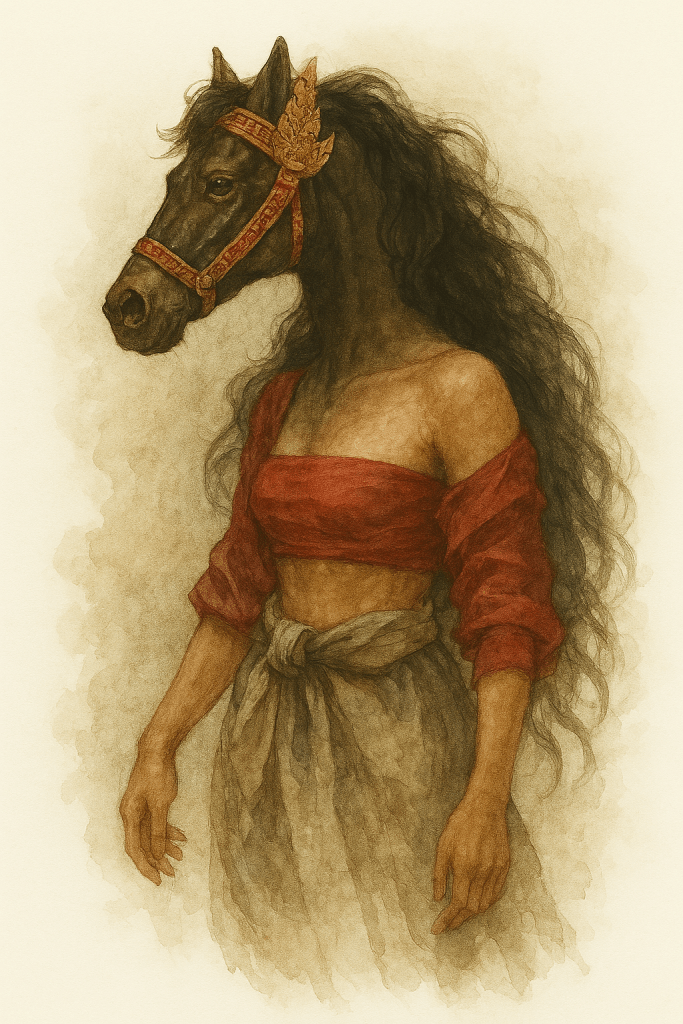
Kaew Na Ma is one of Thailand’s most intriguing folk tales—an emotionally rich story that defies traditional expectations. Unlike many Thai legends where male heroes dominate the narrative, Kaew Na Ma centers on a female protagonist who overcomes ridicule, danger, and rejection to rescue the man she loves.
Her name, Kaew Na Ma, literally means “Kaew with the face of a horse.” Though her appearance is mocked, her heart is noble, her mind sharp, and her loyalty unwavering. This tale explores themes of transformation, inner beauty, and the quiet strength of women who fight not with weapons, but with wisdom and love.
Rooted in Thai oral tradition and adapted across generations, Kaew Na Ma remains a rare gem—a story where the heroine saves the prince, not the other way around. It invites readers of all ages to reflect on how we judge others, and what true beauty really means.
Whether you’re new to Thai folklore or a lifelong lover of Southeast Asian storytelling, this tale offers a fresh perspective on courage, compassion, and the power of being underestimated.
Let’s read the story of “Kaew Na Ma” together.
Once upon a time, in the peaceful kingdom of Pangthong, there lived a wise king and a kind queen. They had one son—Prince Pintong. He was handsome, clever, and beloved by all.
As Prince Pintong grew older, he longed to explore the world and learn beyond the palace walls. The king and queen agreed, sending loyal attendants to accompany him.
The prince traveled far—through cities, forests, and villages—until he reached a deep jungle where a powerful hermit lived. The hermit welcomed him kindly and told him of a young woman named Kaew Na Ma.
Kaew Na Ma had the face of a horse—strange and unlike other women. But the hermit said she was wise, brave, and gifted with the power to change her form
When Prince Pintong met Kaew Na Ma, he was startled by her appearance. But as they spoke, he saw her cleverness, her courage, and her heart. Slowly, admiration grew.
Then one day, disaster struck. The prince was captured by bandits and locked in a cave deep in the forest. His attendants fled in fear. Only Kaew Na Ma stayed.
She searched for him. She used the hermit’s teachings, her wit, and her bravery. Disguised as an old wanderer, she went to a nearby village, pretending to sell herbs to gather clues.
Once she learned the cave’s location, she made a plan. She feigned illness and asked the bandits to let her rest inside. Then, she served them food laced with sleeping herbs. When they fell asleep, she freed the prince and led him to safety.
Prince Pintong was deeply moved. “Though your face may not be fair,” he said, “your heart is more beautiful than any in the land.” He chose her as his bride, despite objections from the royal court.
Back in Pangthong, the king and queen were disappointed by her appearance. So the prince quietly kept her in his private quarters. Though mocked by many, Kaew Na Ma never grew bitter. She cared for the prince with love and loyalty.
One day, war broke out. Prince Pintong had to fight a neighboring kingdom led by a powerful general who used magic in battle.
Kaew Na Ma offered to help. She transformed into a graceful woman named Mani—a diplomat with charm and wisdom. She traveled to the enemy city, won the general’s trust, and learned his battle plans.
She returned swiftly and shared everything. Prince Pintong prepared wisely and won the war.
The king and queen saw Mani and adored her, wishing she could be their daughter-in-law—unaware she was Kaew Na Ma in disguise.
Prince Pintong knew the truth but kept silent. Until one day, he spoke it aloud. The king and queen were shocked—and ashamed.
They apologized to Kaew Na Ma and welcomed her with honor. A grand celebration was held.
Kaew Na Ma revealed herself and said, “I never held anger in my heart. I always believed… goodness will shine when the time is right.”
From that day on, Kaew Na Ma was respected by all. She helped govern the land, plan wisely, and care for the people.
Prince Pintong loved her more each day. And when she returned to visit the hermit who raised her, she received blessings and magical gifts to aid her kingdom.
And so, Pangthong grew more peaceful than ever—thanks to one woman, whose face was not fair, but whose heart was the fairest of all.

 นิทานนำบุญ