“The Little Hedgehog and the Yogi” is a simple yet deeply meaningful tale — one that holds a special place in my heart.
I created this story not from a plot, but from a playful idea: what if a story could be told in colors?
Before the first word was written, I had already imagined the ink — red for one character, blue for the other, and purple for the moment their worlds finally meet. These colors are not mere decoration; they are the voices of the story itself — symbols of solitude, discovery, and connection.
My stories are usually gentle — soft as a whisper, calm as a breeze. Yet hidden beneath that gentleness lies a quiet mischief, a kind of creative play that challenges me as a storyteller. This tale, in particular, was my favorite kind of challenge: to weave emotion, color, and meaning together until they became inseparable.
For me, this story is more than a fable. It is an experiment of the heart — and perhaps, one I may never be able to create again.
I hope readers everywhere will feel its tenderness and sense its quiet smile — the kind that lingers long after the final page.
Let’s read “The Little Hedgehog and the Yogi” together
Once upon a time, at the quiet edge of a forest, there lived a little hedgehog all alone. No one wanted to come too close — after all, his sharp quills were not made for cuddles. And so, he often sat by himself beneath the trees, tears rolling down his tiny cheeks.
At that very same time, deep in another part of the forest, lived a yogi in solitude. Few dared to approach him — a man who enjoyed playing with nails and sharp objects for meditation. He, too, often found himself alone, his tears falling softly as if no one were meant to see them.
One morning, the little hedgehog thought, “There must be someone out there who would be my friend — someone who would hold me when I feel small and tired.”
That very same morning, the lonely yogi whispered, “There must be someone who would be my friend — someone who would let me hold them when I feel weary and dull.”
The little hedgehog decided to go on a journey to find a friend. To everyone he met, he asked politely, “May I have a hug?”
The yogi, too, began to wander in search of companionship. Whenever he met someone, he asked himself quietly, “Could this be the friend I’ve been searching for?”
The little hedgehog met a fluffy white rabbit and asked, “May I have a hug?” But the rabbit shook its head — afraid the sharp quills might poke holes all over its soft fur. So the hedgehog went on, still searching for someone who would let him hug them.
The yogi met a forest rabbit as well. He tried to hug it and asked himself, “Is this the friend I’ve been looking for?” He shook his head. The rabbit’s fur was too soft, too cushiony — not the kind of sharp, tingling feeling he secretly enjoyed. And so, he continued his journey, longing for a touch that would spark something alive.
Next, the little hedgehog met a thick-skinned rhino. Overjoyed, he thought, “Surely the rhino won’t fear my spines!” He asked, “May I have a hug?” But the rhino quickly refused, saying, “I’m terribly ticklish! A thousand pokes at once would make me laugh all day!” And so, the hedgehog trudged on, still hoping to find someone who wouldn’t mind his prickles.
The yogi, too, met a rhino and smiled at the sight of its sturdy horn. “Ah, a kindred spirit,” he thought. But when he hugged the rhino, the single horn wasn’t enough to give him the delightful sting he longed for. He sighed, bowed politely, and went on his way.
The little hedgehog kept asking everyone he met for a hug, but no matter how gently he asked, no one dared let those spines touch their skin. At last, he sat on a fallen log at the edge of the forest, sighing, “Maybe there’s no one in the world who would ever want to hug me.” Just then, he felt something — a quiet pull, as though someone unseen were guiding his eyes toward the other end of the log.
The yogi had hugged many along the way, but none ever felt quite right. “Will there ever be someone,” he wondered, “who makes me feel both warm and alive when I hold them?” Weary and thoughtful, he sat down on a log at the forest’s edge — and suddenly felt a strange, gentle pull leading his gaze to the far end of that very same log.
The little hedgehog looked — and saw the yogi looking right back at him.
And the yogi, in turn, saw the little hedgehog staring up with bright, curious eyes.
In the hush of the forest, time seemed to stop. At last, the little hedgehog asked softly, “May I have a hug?”
The yogi smiled — a wide, open smile — and said, “You may.” He spread his arms, and the hedgehog, spikes and all, climbed in without fear.
Warmth flowed between them. The yogi’s skin tingled with the sharp sweetness he had always longed for, and the hedgehog’s heart filled with a joy he had never known.
They stayed that way for a long, long time — two lonely souls who had finally found the one hug meant just for them.
From that day on, the little hedgehog was never lonely again. And neither was the yogi.
Their friendship — born of warmth, a touch of pain, and a lot of heart — glowed quietly ever after, in a color the world had never seen before: the color of love, somewhere between red and blue.
The End
.
Someday, you’ll meet the one who fits — gently, perfectly, just as you are.
#NitanNambun — Tales that find warmth in quiet hearts
This is a simple story — one of the simplest I have ever written. It has no grand adventure, no clever twist, and no hero who saves the world. Yet, for reasons I still cannot fully explain, it has touched the hearts of many readers — including my own.
Perhaps it is because this tale was not written to impress anyone. It was written quietly, like a whisper from somewhere deep inside — a place where love, loss, and hope live together in silence.
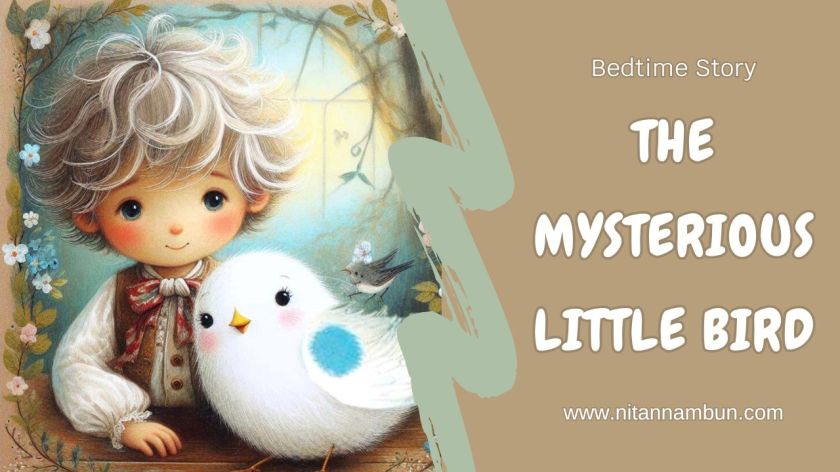
The Mysterious Little Bird is a story that does not ask you to cry, but some readers do. It does not ask you to feel moved, but somehow, by the end, your heart may grow softer without you realizing it.
So, if you are ready, take a moment to slow down, breathe, and open your heart to something gentle and small — a little story that may not change the world, but might quietly change the way you see it.
Let’s read “The Mysterious Little Bird” together
Once upon a time, there was a little boy with a head full of fluffy hair. He was an orphan. Since the day his parents passed away, he had to move into a crowded orphanage — a place he never really liked. He didn’t enjoy being around too many people, so he often went out alone to sit quietly in a field of flowers.
When the boy was there, all by himself, he liked to sprinkle seeds over his soft, fluffy hair to call the birds to come and eat. Sometimes, they even made tiny nests in his hair and rested there. The boy loved listening to the birds sing, for their songs eased the loneliness in his heart.
One day, while he was thinking of his parents, a small white bird appeared. It had a blue spot on its right wing and a pink spot on its left. The bird landed gently on his lap and chirped the sweetest sound he had ever heard.
The boy remembered — his father loved the color blue, and his mother loved pink. So he couldn’t help thinking that this little white bird might have been sent by his parents to visit him from the heavens above.
Believing so, the lonely boy decided to write a letter for the bird to deliver to its “masters.” He wasn’t sure if the bird could really send messages, but each time it returned to rest on his fluffy hair, the old letters he sent with it were never there.
Day after day, the boy wrote new letters to his beloved parents. Sometimes he told them about happy things that happened, sometimes he wrote about his loneliness, and sometimes he even wrote little fairy tales for his parents to read in heaven. Writing those letters made him truly happy.
But one day, the boy became very ill. He grew too weak to go to the flower field, and even holding a pen became too hard. The white bird came quietly to watch over him at his bedside, but in the crowded orphanage, his condition only worsened.
While the boy was gravely ill, news arrived that the King and Queen were coming to visit the orphanage. No one knew why Their Majesties wished to come, but everyone hurried to clean and prepare the place.
When the King and Queen finally arrived, instead of speaking with the staff, they looked carefully around the room — as though searching for something. And when their eyes fell upon a small bed where a white bird sat perched, they walked straight toward it.
The King and Queen gazed upon the sick boy with great tenderness. Then, in gentle voices, they said,
“So it was you… the one who wrote all those letters. This little bird brought them to us every day. The more we read, the more we longed to meet you. And when your letters suddenly stopped, we realized how much you meant to us. We have no children of our own… Would you let us be your parents?”
The boy was too surprised to speak at first. Then tears welled up in his eyes. He reached out and embraced his new father and mother, his heart overflowing with joy.
From that day on, the King and Queen — now filled with happiness — improved the orphanage and often invited the other children and families who wished for children of their own to gather in the royal garden under warm sunlight and gentle breezes.
As for the little white bird with blue and pink spots upon its wings, it seemed happy to see everyone smiling. And then, it quietly flew away toward the heavens, leaving behind a mystery that would never be solved — not in this life, nor the next.
In quiet moments, love still finds its way to you.
NitanNambun — Tales that speak softly, and stay quietly in the heart
A quiet ending filled with love — where a lonely child finds warmth, and a little bird quietly disappears into the sky.
In a world filled with heroic stories, writing a tale about a small hero who rises against darkness is never easy. Stories like this — often called adventure fables or heroic animal tales — are everywhere. But creating one that feels truly different, truly heartfelt, is a rare challenge.
This story began with a faint childhood memory: a black-and-white television, a classic cartoon flickering on the screen, and a little boy staring in wonder. That boy was me. I couldn’t recall the plot, but I remembered the feeling — the quiet magic of a hero stepping forward to protect others.
Years later, I closed my eyes and tried to capture that feeling again. I saw moonlight. Not magical moonlight that transforms or grants powers, but ordinary moonlight — soft, silent, and real. I imagined a hero who didn’t change shape, but changed hearts. And in that moment, the image of a rabbit appeared.
That’s how The Moonlight Rabbit was born.
When I first published this story in a magazine, it received no feedback. I assumed it wasn’t very good. But when I later shared it on my website, something unexpected happened: the story quietly soared to over 100,000 views — far beyond the typical print run of children’s books in Thailand.
So I decided to translate it. Not just into English, but into a form that would preserve its soul — the gentle tone, the quiet bravery, and the moonlight that never needed to be anything more than itself.
This is The Moonlight Rabbit. May it shine softly in your heart, wherever you are in the world.
Let’s read “The Moonlight Rabbit” together
In the ancient legends of the rabbits, there was once a tale about the Moonlight Rabbit — a guardian who always protected and saved young bunnies from danger. Every little rabbit admired the Moonlight Rabbit as their hero, and many dreamed of becoming one when they grew up.
Among them was a young bunny named White Cloud, who longed to become a Moonlight Rabbit someday. White Cloud’s grandfather once told him that the moon would grant its power to a brave rabbit, so that the rabbit could use the light of the moon to fight against evil in times of peril. From that day on, White Cloud made a vow to himself — he would be brave, so that the moon would one day grant him its power.
White Cloud’s friends often laughed whenever he spoke of his dream. Although every young rabbit dreamed of becoming a Moonlight Rabbit, White Cloud was so small and fragile that no one believed he could ever protect anyone. To them, his dream of becoming a hero was just a funny joke.
But even though White Cloud was teased again and again, he never lost heart. He never gave up on his dream — not even once.
One cold evening, while White Cloud was out in the forest collecting sticks to make a fire, a hungry pack of wolves attacked the rabbit village. They caught every rabbit they could find and locked them inside a large white tent in the middle of the village. The wolves planned to take all the rabbits away the next morning and keep them trapped in a cave as food for the winter to come.
Inside the tent, many rabbits were so frightened that they began to cry, knowing the terrible fate that awaited them. Seeing the little rabbits trembling with fear, White Cloud’s grandfather decided to tell the story of the Moonlight Rabbit, hoping to calm them down.
The wolves guarding the tent grew angry when they heard the old rabbit’s tale. They stomped toward him and ordered him to be silent, threatening that they would not hold back their rage if he continued. The old rabbit stopped, but he also noticed something strange — the wolves’ faces looked pale, as if the story frightened them. At that moment, he did not yet know that the tale of the Moonlight Rabbit, loved by rabbits everywhere, was actually a terrifying legend among wolves.
Late that night, White Cloud returned home with his bundle of sticks. A bright blue moon shone across the sky. He was puzzled to see that all the houses in the village were dark. In the middle of the village stood a white tent glowing faintly with candlelight.
“What has happened?” he wondered, his ears twitching.
When he listened closely, he heard the sound of rabbits sobbing inside the tent. Then, a foul scent drifted on the wind — the smell of wolves.
White Cloud’s fur stood on end. He instantly knew that something terrible had happened to his village.
He had two choices: run away and save himself, or find a way to rescue the others. The little rabbit trembled with fear. How could someone as small as he fight against a pack of wolves?
He hesitated — and then his grandfather’s words echoed in his mind:
“The moon will grant its power to a brave rabbit, so that he may fight evil in times of danger.”
White Cloud looked up at the shining moon with determination. No one else could save the rabbits now — except him.
He prayed quietly to the moon for courage. Then, gathering every bit of bravery within him, he climbed onto a small hill that stood between the tent and the moonlight. He lifted the sticks he carried high above his head and waved them fiercely in the air, shouting with all his might to drive the wolves away.
The sudden cry broke the silence of the night. The wolves and the rabbits inside the tent were startled. When the wolves looked toward the tent’s white wall, they froze in terror — for there, cast by the moonlight, was the enormous shadow of a giant rabbit, its claws raised high as if ready to strike.
The wolves screamed and fled into the forest, disappearing without a trace.
Inside the tent, the rabbits began to cry — not from fear, but from joy. They called out to the Moonlight Rabbit, asking their hero to appear before them.
White Cloud slowly stepped into the tent. As he entered, the giant shadow vanished, leaving only the small figure of a little white rabbit holding two dry sticks in his paws.
For a moment, everyone was silent. Then smiles spread across their faces. This was the true Moonlight Rabbit — the one who had saved them with courage, not strength.
From that night on, the story of White Cloud, the Little Moonlight Rabbit, was passed down from generation to generation — a tale to remind all rabbits that even the smallest heart can shine with the light of the moon.
Courage begins quietly — and shines brightest in the darkest hour.
#NitanNambun — Tales that bring kindness to life
The Moonlight Rabbit stands beneath the moonlight, ready to protect his village — from the story by Nitannambun.
If this story touched your heart, feel free to share it with someone you love.
This story was inspired by a real moment in my life. More than twenty years ago, a British man—who was a friend of my senior—came to Thailand in search of work. At the time, he faced difficulties with housing and finances. My senior asked if I could offer him a place to stay temporarily, and I agreed.
After living in my home for a while, he asked me why I had helped him so much. I told him I didn’t expect anything in return. I simply hoped that, one day, if he met someone in need, he might remember this kindness and offer help in return.
That thought stayed with me. I began to wonder: what if kindness could travel from person to person, like a gift passed hand to hand? And so, The Journey of Happiness was born—a gentle tale about a rare flower, a secret tunnel, and the joy that grows when we choose to share.*
Let’s read “The Journey of Happiness” together
Deep beneath the earth
Almost no one knows that beneath our world lies a secret network of tunnels. These tunnels connect different lands together — and only the animals know their secret paths.
The panda’s gift
One sunny morning, a little panda was happily munching on bamboo leaves. Suddenly, he noticed a rare and beautiful flower blooming shyly behind a clump of bamboo.
The panda knew that this special flower would bloom for only one day before it wilted. He wished his best friend, a penguin living far away at the South Pole, could smell its sweet fragrance too.
If he traveled the normal way, the flower would fade for sure. But the panda knew where the secret tunnel began! So, he placed the flower carefully in his basket and hurried through the hidden passage — all the way to the icy land of the penguin.
The penguin’s idea
The little penguin was overjoyed to receive the rare flower from the panda. After his friend returned to China, the penguin thought, “I want to share this lovely scent with the baby kangaroo in Australia.”
Once again, the journey was too long for the flower to survive. But the penguin also knew the way into the secret tunnel! He gently carried the basket in his beak and waddled through the hidden passage — until he reached the kangaroo’s warm and sunny home.
The kangaroo’s hop
The baby kangaroo was delighted to get the rare flower from the penguin. After the penguin went home, the kangaroo thought, “I’d love my friend, the little elephant in Africa, to smell this beautiful flower too.”
So, he tucked the flower safely into his pouch and hopped—boing, boing, boing—through the secret tunnel, all the way to the great plains of Africa.
The elephant’s surprise
The little elephant was thrilled to receive the flower from the kangaroo. But soon, he too wanted to share the happiness.
“I’ll give it to my best friend,” he said. And his best friend lived far away… in China.
He wrapped his trunk around the basket, stepped into the secret tunnel, and followed its winding path back to his dear friend’s home.
Full circle of joy
Do you know who the elephant’s best friend was? That’s right — the same panda who had first found the flower!
The panda was amazed and overjoyed to see the rare flower again. In just one day, it had traveled around the world and come back to him.
If he hadn’t shared the flower, he might have had to wait many years to see it again. But because every friend wanted to make another happy, the journey of happiness began — and never truly ended.
Happiness grows when you share it.
#NitanNambun — Tales that bring kindness to life
If this story touched your heart, feel free to share it with someone you love.
Twelfth Night หรือชื่อเต็มว่า Twelfth Night, or What You Will คือบทละครแนวตลกโรแมนติกที่เขียนโดย วิลเลียม เชคสเปียร์ (William Shakespeare) กวีและนักเขียนบทละครชาวอังกฤษผู้ทรงอิทธิพลที่สุดในประวัติศาสตร์วรรณกรรมโลก ผลงานชิ้นนี้ถูกเขียนขึ้นราวปี ค.ศ. 1601–1602 เพื่อแสดงในช่วงเทศกาลฉลองหลังคริสต์มาส โดยมีเนื้อหาเกี่ยวกับการปลอมตัว ความรักที่ซับซ้อน และความเข้าใจผิดอันแสนสนุก